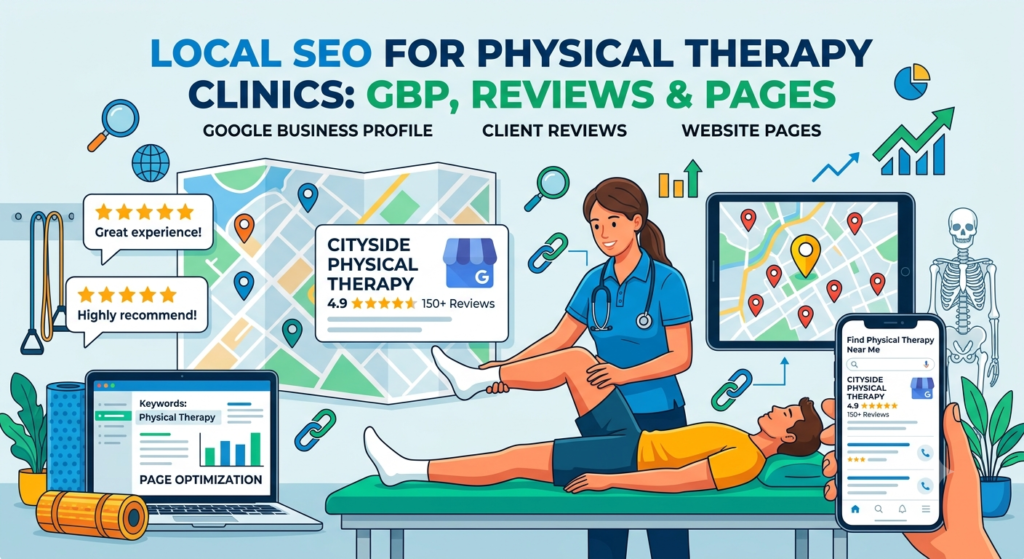
Mastering physical therapy local SEO is essential for clinics trying to attract patients in their immediate neighborhood. When someone twists an ankle or wakes up with debilitating lower back spasms, they rarely flip through a phone book or wait for a slow physician referral. They pull out their smartphone and search for immediate care nearby.
If your clinic fails to show up in the top three map results, those patients go straight to your competitors. Implementing a dedicated local SEO for physical therapy clinics strategy ensures your practice captures this high-intent search traffic.
Why Most Physical Therapy Clinics Struggle with Local SEO
Many clinic owners wonder why their website gets very little traffic despite having a modern design. The issue usually stems from a mismatch between how clinics market themselves and how patients actually search.
The shift from physician referral to direct consumer search
Historically, orthopedic surgeons and primary care doctors controlled the patient pipeline for physical therapy. Today, direct access laws mean patients can book an evaluation without a physician’s note in most states. Patients searching for local care use intent-driven phrasing rather than brand names. They type specific queries like sciatica relief or post-op knee rehab into search engines, bypassing clinics that rely solely on word-of-mouth.
Why broad national keywords fail local healthcare practices
Trying to rank for broad terms like physical therapy or sports rehab is a losing battle for a local clinic. You are competing against massive aggregator directories, national telehealth brands, and health systems with millions of dollars in domain authority. Most clinics also suffer from poor website architecture. They lump all treatments onto a single, thin service page that fails to convert map traffic into scheduled initial evaluations.
Optimizing Your Google Business Profile for the Map Pack
Your Google Business Profile is often the first interaction a patient has with your clinic. Getting this asset right is the single most effective action you can take to improve your physical therapy SEO performance.
Choosing the right primary and secondary categories
Log into your Google Business Profile dashboard and select Physical Therapist or Physical Therapy Clinic as your primary category. Do not choose generic options like Health Consultant or Wellness Center. Add secondary categories that reflect your specific offerings, such as Sports Medicine Clinic or Orthopedic Clinic, but only if you actually provide those treatments daily.
Writing a location-rich business description
Your business description should clearly state what you treat, who you help, and where you are located. Avoid keyword stuffing. Instead, write a natural summary like, Outpatient physical therapy clinic in Austin, Texas, specializing in orthopedic rehabilitation, back pain relief, and post-surgical recovery. Keep it focused on the patient’s immediate needs.
Adding services, attributes, and photos that build patient trust
Fill out the services section completely, listing every major condition and treatment modality you offer. Ensure your exact NAP (Name, Address, Phone) details match your website footer and directory listings down to the suite number. Upload authentic photos of your facility, treatment tables, exercise equipment, and friendly staff members instead of generic stock imagery. Patients want to see the actual environment where they will be sweating and recovering.
Building Patient-Centric Condition and Service Pages
A high-performing physical therapy website needs a page for every major injury and treatment you handle. Grouping everything onto one page misses valuable search intent.
One intent per page: separating conditions from treatments
Create dedicated pages for high-value conditions you treat locally, such as rotator cuff tears, plantar fasciitis, and lower back pain. Separate these from your treatment pages, such as manual therapy or dry needling. A patient searching for shoulder pain relief wants to read about shoulder pain symptoms and recovery paths, not a generic definition of manual therapy.
Anatomy of a high-converting physical therapy service page
Each condition page should address patient pain points, symptoms, and expected recovery milestones directly. Explain what an initial evaluation looks like at your clinic to reduce first-time patient anxiety. Include clear, unmissable calls to action for booking an initial evaluation, supported by your phone number and an online scheduling widget.
Structuring Location Pages for Multi-Clinic Practices
If your practice operates across multiple neighborhoods or suburbs, you need a disciplined approach to managing your digital footprint.
Unique content requirements for each clinic location
Never copy and paste the same page text across different location pages while just swapping out city names. Every location page must feature distinct staff bios, local landmarks, parking tips, and clinic-specific photos. If one clinic is near a major commuter highway and another is downtown, highlight those local logistics clearly.
Embedding localized maps and schema markup
Embed a Google Map pointing directly to each specific office on its respective location page. Implement LocalBusiness schema markup in your site’s code to help search engines parse your physical coordinates, operating hours, and geo-targeted service areas accurately. This technical foundation supports our broader digital marketing services and ensures search engines map your locations correctly.
A Sustainable System for Collecting Patient Reviews
Reviews heavily influence both local map rankings and patient conversion rates. You need a proactive, repeatable process to gather them.
Timing review requests during the patient lifecycle
Trigger review SMS or email requests automatically when patients reach key recovery milestones, such as graduating from a care plan or achieving full range of motion. Do not ask for reviews on day one when the patient is still sore and overwhelmed. Pick the moment when they are most grateful for their renewed mobility.
Responding to reviews in a HIPAA-compliant manner
Never mention specific medical conditions, injuries, or treatment details in your review replies to maintain strict patient privacy. Keep your responses warm, professional, and generalized. For example, reply with, Thank you for the kind words, John! It was a pleasure helping you get back to your favorite activities. Maintain a steady cadence of new reviews rather than acquiring them in sudden, suspicious bursts.
Citations and Local NAP Consistency
Search engines cross-reference your business data across the web to verify your legitimacy. Inconsistent listings erode trust.
Core data aggregators vs. niche healthcare directories
Ensure your practice details match across major data providers like Data Axle and Localeze. Inconsistencies in suite numbers, abbreviations, or phone numbers can confuse search engine crawlers and suppress your map visibility.
Auditing and fixing inconsistent listings
Claim and clean up profiles on healthcare-specific directories like Healthgrades, WebMD, and Vitals. Regularly audit your directory footprint to ensure old addresses or disconnected phone numbers are updated immediately. This cleanup process pairs well with comprehensive SEO services to build absolute trust with search algorithms.
Measuring Local SEO Success and Conversion Tracking
Tracking the right metrics proves whether your local optimization efforts actually drive revenue for your practice.
Tracking calls from Google Business Profile insights
Use dedicated call tracking numbers specifically on your Google Business Profile to measure direct phone inquiries generated from the map pack. Monitor local pack ranking improvements using localized rank tracking tools that show your visibility block by block across your target city.
Setting up goal tracking for booking evaluations
Configure conversion tracking in your analytics platform to measure every time a user clicks your booking button, submits a contact form, or calls from your website. Understanding these conversion pathways helps inform broader web development services to streamline your patient intake funnel.
Frequently asked questions
How long does local SEO take to bring new patients to a PT clinic?
Local SEO typically takes three to six months to generate consistent new patient traffic. The timeline depends heavily on your local market competition, your current Google Business Profile authority, and your ongoing review collection velocity.
Should I create a separate page for every condition I treat?
Yes, breaking down conditions into individual pages helps capture high-intent long-tail search traffic from patients looking for specific injury recovery. It also shows search engines that your clinic holds deep expertise in treating those specific ailments.
Can I respond to Google reviews mentioning patient conditions?
No, replying with patient health details violates HIPAA guidelines. Keep review responses professional, warm, and general without referencing any diagnoses or specific treatments.
What is the most important ranking factor for physical therapy local SEO?
Proximity, relevance, and prominence of your Google Business Profile represent the core ranking pillars. These factors work best when combined with consistent five-star reviews, clean NAP citations, and localized onsite content.
Ready to dominate local search and fill your physical therapy schedule? Partner with Enresult for specialized SEO services tailored to healthcare clinics. Contact Enresult today to book your free strategy call and discover how our digital marketing services can help your practice grow.